Writing well by doing violence, at @Tordotcom

stubby the rocket
Thumping Great Crimes is the next in the intermittent crime series on Tor.com: as the title implies, it’s about writing about violence. The violence in this case is the type that falls short of murder: assault, fight scenes… thumping.

I will probably move on (or up?) to murder itself in the next article.

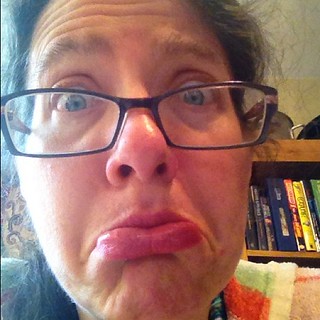
Meanwhile, here’s an assault on your senses: I’m still playing with the iPad and the Paper Camera app, with the resulting beeyooteeful self-portrait:

Still not tired of playing with iPad filters...

________________________________
*Stubby the Rocket appears with the permission of the kind permission of the Tor peeps


Literary blackmail, televised DIY surgery and other lite squicks

I wrote a post this week for TOR.COM, about blackmail in fiction, and in Veronica Mars. The post is here; I hope to follow it up with some musings on other varieties of crime. Let me know what you think?

Second: I dunno how many of you have seen this past week’s new episode of a certain medical drama, so I’ll confine my comments on that to “OMG, squick! Ewww!” Either you know what I mean or that evil chuckle you hear is your DVR, waiting for you to boot it up.

Also TV adjacent, I am 3/5 of the way through watching Mildred Pierce on HBO and should probably hold my tongue until I see the conclusion, but I have to say that as viewing experiences go, this one so far has been entirely bizarre. Kate Winslet is fantastic, as usual, and her Lauren Bacall accent is a marvel to hear. And I’m always so happy to see Melissa Leo in anything.

But the story–I haven’t read the original novel–has all this peculiar class and gender stuff.

The message so far seems to be that men are useless parasites, and… um… something about social class and snobbery involving Guy Pearce’s naked bum. Seriously. The class stuff is, at this mid-point in the story, entirely murky. Mildred was a snob, but now she seems to be evolving. Unless she isn’t. It’s incredibly hard to tell.

The story is just intriguing enough to keep me watching, but it’s also very cold. Kate as Mildred seems as though she should be poised to be a source of joy and warmth in an otherwise harsh and chilly world, but she’s as icy as everyone and everything else. I am entirely baffled by it.

Fall From Grace

You know how, in a certain type of (often-British) mystery, your protagonist has some big, self-destructive flaw? He drinks too much, he has intimacy issues, he’s all hung up over his lost love or he’s Sherlock Holmes and shoots heroin? It’s sort of grittily romantic, if you have that thing where you sometimes imagine taking people home, feeding them soup and kindly sorting out their lives?

Yeah. So Wayne Arthurson has raised the bar on this particular literary convention. The sport isn’t even high jump anymore… he’s taken it into the realm of pole vaulting.

In Fall from Grace we meet Leo Desroches, a guy so spectacularly screwed up he makes Cracker seem cuddly and functional.

Leo’s a journalist and a full-time mess on legs. He’s been in jail, he’s been homeless, and even though he currently has a job, it’s in Edmonton. (Okay, Edmonton, sorry for the swipe. Where was I? Ohhh… balmy balmy Vancouver.) He has a regular gig at a local paper and a place to live, but he’s also a howling black hole of gambling addiction and bad choices, and he’s found a devilishly inventive and thoroughly shocking way to keep himself out of the casinos.

When he is first on scene at a murder, Leo gets a chance to put his career back on track. And since there are two Leos–the Gambler, and the earnest guy who wants to put his life together and maybe even reboot a relationship with his kids–he makes the most of it, turning one anonymous murder victim into front page news. As he digs deeper, of course, it turns out that poor Ruby Cardinal is hardly the first strangled sex-trade worker of Aboriginal descent to turn up in an area wheat field. The police are officially unaware of the trend, but they’re also more than a little sensitive about the suggestion that there may be a serial killer in the city.

Which is great for Leo, because what self-destructive person wouldn’t want to antagonize the hometown police?

Leo’s investigation brings him all the danger his self-loathing side could hope for and then some. Because Fall from Grace doesn’t pretend to be gritty–it embodies grit. It’s rough-edged and scary, a fascinating crime novel about a guy who can’t quite surrender to his own darkness, even as he continually, compulsively sets himself up to lose every single thing he’s got.

Journey with Jack Dann

Those of you who know I’m a history nerd could probably have guessed that I’d approach Jack Dann for an interview sooner or later: he’s the guy, after all, who wrote The Memory Cathedral – A Secret History of Leonardo Da Vinci! Not only has he won the Nebula, the Aurealis Award, and The World Fantasy Award, he holds the title of Esteemed Knight in the Mark Twain Society.

Jack has been candid and funny and very revealing in this interview about his writing career, and I don’t want to keep you from him a second longer than necessary. So enjoy!

I’m a New York expat living in Australia. I sort of shuffle between our apartment in Melbourne and a small farm in a beautiful part of the country called South Gippsland. It overlooks the sea and a dragon-shaped landmass (and a national park) called Wilson’s Promontory. I live with my wife Janeen Webb, who is an internationally recognized critic, award-winning writer, and a retired university professor. I’ve been writing since the late sixties, and have written or edited over seventy-five books and a bunch of short stories. I’ve won a handful of awards…ach! This is boring stuff!

New and usually young writers tend to put all sorts of dashing things in their bios such as wrestling alligators in Florida and being soldiers of fortune in Algeria. They write that that they train Lipizzaner horses and have pedigreed Manx and Siamese cats that only meow in iambic pentameter. I thought it might be fun to reminisce about the mad old days, so here is some stuff I absolutely and positively would never put into my book bios:

I was…a door-to-door cable television salesman, lifeguard, law investigator, and a law school drop-out. I sold all my text books and became “a freelance writer” the day after Damon Knight accepted one of my stories for his Orbit anthology series. I’ve been a ghostwriter, soup distributor, and a carnival roustabout (that means I cleaned up elephant poo); and I’ve have had my share of nuts sending me death threats, mandalas, and Polaroid photos of their naked selves after they’d read my books. (And here I thought all along that I was writing light, frothy Runyonesque escapist fiction for sophisticates.)

I lived in a hotel in New York City immortalized by Donald E. Westlake—I remember that the doorman wore a tee-shirt and carried a baseball bat. I’ve had two advertising agencies, sat on the board of directors of a New York insurance company, failed at getting a job as a cab driver, worked with the late, great film director Nicholas Ray, and was one of the (God-forgive-me) pioneers in the early days of telemarketing. I was, for a while, the bull-moose loser of Nebula Awards. (Yes, I did win one!) I’ve been a marksman, window-washer, and a lousy jazz pianist. I can’t sing a note and I’ve always had cats as pets…only now we have a dog, a beagle called Bertie Beagleman, who does not respond to commands unless there is food involved: so I suppose I still have a cat of sorts.

Now that’s the kind of bio I don’t write anymore. (Here’s an official bio, from his site, if you want to compare.)


The project of the moment, the project I’m taking a break from to have some fun with this interview, is a book—or rather a series of books—that I swore I’d never write. I’m working on a—I guess one could call it a—fat fantasy series. Although I love fantasy, am a Tolkien reader and re-reader, and love the genre, I really don’t have time for the copycat run of fantasy novels, the badly reupholstered Tolkien knock-offs. I admire (and envy!) the brilliantly original fantasists such as George R. R. Martin, Mary Stewart, R. A. MacAvoy, Ursula K. LeGuin, and Phillip Pullman, but I figured that the big, cosmic, multi-book fantasy genre was just not for me.

Alas, that was a very bad thing for this writer to reveal to his very nasty, noncompliant, and treacherous unconscious. After bragging loudly that I would never ever write such a thing, I just couldn’t stop thinking about it. I didn’t look for ideas…they seemed to be landing all over me like sand-flies in summer.

This fantasy series is set in an alternate Renaissance universe and our universe… and characters can also come from different time periods, which they do! But it is a fantasy, as it assumes the Gnostic Gospels are real, and a number of the characters are angels and demons. Gabriel, for instance, is one of the protagonists.

I have multiple books on the go… I’ve just finished an anthology with Nick Givers entitled Ghosts by Gaslight; am copyediting a Borgo double, which will include my short novels The Economy of Light and Jubilee; compiling three new anthologies to take to publishers; writing the first book of the fantasy series—the book is tentatively titled Shadows in the Stone; doing preliminary work on a book about writing fiction; working with my bibliographer on a second edition of The Work of Jack Dann; some film stuff (no, I can’t discuss any of that yet); and…I think I’ll stop now. It’s hurting my head!

I started writing fiction with the aim of getting published around 1966, and sold my first story (with George Zebrowski) to a magazine called Anubis, which promptly went bust. (We later sold it to a hardcover anthology.) We went on to sell another collaboration to Worlds of If, which was the sister magazine to Galaxy; and that story, “Traps” was published in 1974. So I was in my late twenties. Influences? I’ll try not to bore the reader, but they include F. Scott Fitzgerald, Loren Eisley, J.G. Ballard, Thomas N. Disch, Philip K. Dick, Elizabeth Bowen, J.D. Salinger, Edgar Pangborn, Jerzy Kosinsky, Bradbury, Brian Aldiss, Marquez, Lem, Wells, Gene Wolfe, R. A. Lafferty, Stapledon, Huismans, Mark Twain, John Fowles. I could (but mercifully won’t) go on and on. But if I had to choose just two early influences, it would be Joyce’s A Portrait of the Artist as a Young Man and Salinger’s The Catcher in the Rye.

I do remember a specific moment when I decided to be a writer. I was in a terminal ward, as they didn’t expect me to survive, and I had a copy of Hemingway’s Down and Out in Paris on my bed table. I was too ill with peritonitis to read, but it became a sort of talisman as I swung back and forth between agonizing pain and the numbing, cold blue dreams induced by Demerol. I promised myself that if I survived, I was going to what I wanted to do: Write. That was over forty-five years ago.

(To get an idea of what I experienced, read my story “Camps”.)

I’m a writer, but that’s only a part of what I am. Sure, I could quit, but I don’t want to. It’s the best life I can imagine. I’ve spent a lifetime following my bliss, as Joseph Campbell would say, so I can’t complain. I’ve done other things—door to door salesman, principal partner in two advertising agencies, director of a New York insurance company—but I’ve always written, no matter what. That’s what I do, and, okay, I suppose in my secret heart of hearts (alas, no longer secret!), I am a writer, then everything else.

I began writing SF and fantasy, I grew up reading SF and fantasy, and although I write ‘across genres’, I keep going back to SF and fantasy, two genres I love. I write historical and contemporary novels…I write what interests me at the time, and right now, I’m doing what I swore I’d never do: that fat fantasy trilogy. Go figure!

I don’t believe in the idea of writer as ‘artiste’. When I had a family, and a six book deal went down the tubes, I became a door-to-door salesman, although I’d never sold a thing in my life. A cable salesman came to the door of my newly mortgaged house, and I made a deal with him: If he’d bring me into the cable company, I’d give him writing lessons. I took care of my family, and when I was making enough money writing, I became a full-time writer.

Every writer has to find his or her own path, and it’s always frustrating and difficult to balance art and craft and life. I tell young writers not to quit their day jobs. I tell them to get up early and write, to give yourself that time so the rest of the day can be given generously to all the other tasks of being a person living in the world. I believe that writers need experience…so learn things, take chances, get the best education possible, become streetwise, and don’t let anything get in the way of your writing. By that I mean, don’t make excuses. If you teach in a university, that’s great. But don’t allow that to become a substitute for sitting down to write. I edit anthologies because I love the process of finding new writers and wonderful work: It feels like writing, and gets me through the difficult stretches. But I keep writing, even if it means bumping up against one dead-end after another.

Frankly, those who really want to write will do so…and the rest will just make excuses…legitimate and rational excuses, but excuses just the same.

Oh, and lastly, I’m not good at balancing my life and my writing. I screw it up all the time. But I write!

You know what the real problem is? I need a few more lifetimes. I’m not a fast writer, and there are so many projects I have in mind. Right now I’m writing the fantasy based on the Gnostic Gospels. If I can stay alive and compos mentis long enough, there are dozens of novels I’d like to write.

I was lucky, as I began selling fiction immediately. I think that was a question of being in the right places at the right times. As I said, everyone’s path is different. I taught myself how to write by writing short stories…and the short stories kept getting longer and longer until I found myself just warming up around the hundred thousand word mark. Yes, there were big sacrifices, but I didn’t notice them until later. It’s romantic when you’re young to be living out there on the edge, not knowing where the next dollar might be coming from; but doing the hustle becomes more difficult as the years weigh down and the midriff bulges. I’ve spent my life living at two hundred miles an hour…with almost no regrets. (I used to say ‘no regrets’, but I’ve discovered you can’t really be alive and not have regrets.

I didn’t go to Clarion, although I’m a big fan and have been a tutor twice at Clarion South in Australia. But workshops were very important to my early growth as a writer. I was one of the original members of the Guilford Writers Workshop and later the Philford Writers Workshop. I wrote about that time in my collection of collaborative fiction entitled The Fiction Factory. Here’s a relevant bit from the book:

Gardner (Dozois) brought me into the Guilford Writers Workshop, which used to meet in Jack C. Haldeman II’s decaying four-story Victorian mansion in the Guilford section of Baltimore; and I became a regular member of the group called the Guilford Gafia (nicknamed after “The Milford Mafia,” which was what some people were calling Damon Knight’s and Kate Wilhelm’s now legendary Milford Writers Conferences). Our group comprised Jack and his brother Joe W. Haldeman, George Alec Effinger, Gardner, Ted White, Tom Monteleone, Robert Thurston, William Nabors, and myself.

Guilfords would last a weekend, a weekend of concentrated, exhausting work: staying up most of the night reading the stories to be workshopped the next day, then workshopping, reading, eating together, partying; we were creating our group mythology, creating fast friendships, as we honed our critical and writing skills. It was the Guilfords, and later the Philford Writers Workshops that paved the way for the frenetic, prolific, never-to-be-repeated Fiction Factory days of the eighties.

The Philfords included writers such as David Hartwell, Samuel R. Delany, John Ford, James Patrick Kelly, Timonthy Sullivan, Tony Sarowitz, Greg Frost, and Tom Purdom. And the “Fiction Factory” days that followed was the time I honed my short story skills and collaborated on short fiction with Gardner Dozois, Michael Swanwick, and Susan Casper. We were selling to the slicks such as Playboy, Penthouse, Omni, Oui, and actually making reasonable money for short stories. So, yes, workshops for me were an education. But many writers do not do well in a workshop environment. Depends on the writer. We all approach writing differently, reach our literary goals by weird and wonderfully circuitous ways, so what worked for me might be anathema for you.

I do remember a moment of artistic breakthrough…in fact, I remember a few. One will suffice. (Yes, gentle reader, you can breathe easier now.) I was writing my second novel, Junction, and I just could not find the right ending. I was thoroughly, completely, unreservedly blocked, so I read anything that felt somehow relevant to what I was working on; I chewed my fingernails, went to movies, took long walks; and finally was about to give it up and start another project. I remember taking a nap in the afternoon. I had pulled the drapes across the windows, yet I had not turned off the bare light bulb that hung over the bed. I remember being jolted awake by an explosion of light. Nothing miraculous had happened. The light was still on. I was staring up at it. But in that instant I saw the end of the novel, scene-by-scene in absolutely perfect detail. It only remained for me to write it down. Go figure.

I don’t know if that’s what you were asking. It’s probably not a breakthrough in the sense you meant it, but what the hell, it’s what came to mind. Ask me about Harlan Ellison and public speaking in another interview: now that was a breakthrough!

I think the big surprise was that publishers would buy my novels. I always had the sneaking suspicion that I was fooling them, getting another one past them…and other writers tell me that they feel the same way. We’re really all phonies, you know. Once the publishers realize that, the jig is up for all of us. The bad surprises? Ah, rejection…but then, as we all know, that really isn’t a surprise.

It still feels great. Which definitely proves that there must be something seriously wrong with me.

One Ring Circus, by Katherine Dunn

My UCLA novel-writing class is in workshop at present, which really slows down my intake of fiction, so instead I’ve recently read Katherine Dunn’s One Ring Circus: Dispatches from the World of Boxing.

Katherine was one of my instructors at Clarion West 1995; she is a generous teacher, honest and full of enthusiasm and passion for writing. She brings that same fierce love to boxing, and what I loved most about this series of boxing articles tended to be her physical descriptions of fighters–there’s a painterly sensuality to the way she talks about these men and women that differentiates them from each other so clearly. It’s a nifty trick, the more so because, as someone who’s not a fan, it would be easy to just have a generic picture of some ‘fight guy’ in one’s mind while reading.

Journey with Elizabeth Bear

I know and admire Elizabeth Bear‘s writing–I had the good fortune to review Hammered when it was first released, and rave about Carnival, every chance I get. I teach her story “Two Dreams on Trains” in my Writing the Fantastic course at UCLA.

I forget, sometimes, that she and I have never met. I follow her Twitter feed and her blog, where she talks about her passions, writing craft, and the artistic life with its constant juggles and challenges. It all comes across as real and familiar; it resonates with me. I feel as though I know her Giant Ridiculous Dog and cats, though in fact I don’t. I’m one of the many readers who never misses her Criminal Minds recaps, which are charmingly filed under the Geeks with Guns tag.

Even though she is an unselfish and honest blogger, I asked her to do a Journey interview out of sheer greed, just so I and you could get to know her a bit better.

Elizabeth Bear
PHOTO BY S. SHIPMAN

Here’s what she told me:

I live in Manchester, Connecticut, with a giant ridiculous dog, a presumptuous cat, a room-mate, and the roomie’s cat, a giant fluffy monster. I love to cook, and do it recreationally; I am an apprentice gardener and a really lousy guitar player; and I have a collection of outdoor hobbies including kayaking, rock climbing, and hiking. I read compulsively, and I’m a third-generation SF fan on both sides of the family.

I tend to have a lot of irons in the fire in terms of projects. There’s Shadow Unit, of course–tons of free online fiction in a semi-interactive, semi real-time narrative, written by some of SFF’s best writers, established and new. I’m fortunate to be doing a lot of teaching this year–Clarion, Viable Paradise, and I’m a guest lecturer at Odyssey this fall. And I have three books coming out this month (two of them delayed from last year): The White City, a vampire novella set in an alternate Moscow around the turn of the 20th century; The Sea Thy Mistress, a periapocalyptic Norse technofantasy, the third in the Edda of Burdens trilogy; and Grail, far-future science fiction about posthuman explorers aboard a generation ship, the third in the Jacob’s Ladder trilogy.

Elizabeth Bear

I also just delivered Range of Ghosts, which is the first in a new epic fantasy trilogy I’m very excited about. It’s nearly unique, I think, in that its setting is Eurasian and Central Asian rather than European. It’s not a historical fantasy, however, but an attempt to create a fantasy setting that draws from different backgrounds than most Western fantasy.

I’ve spent a good deal of my life trying to find a real profession, something that might lead to financial stability and regular access to healthcare, but storytelling seems to be the only thing I’m any good at.

I’ve been writing fiction since I figured out that stories came from somewhere. Which is pretty much first grade, as far as I recall. I remember writing little stapled “books” of stories about dinosaurs and race horses and aliens. Apparently, this is the thing I was meant to do.

Oh, I have quit. And I have worked at various other jobs from the time I was sixteen until I was thirty-six, more or less. Some of them didn’t leave a lot of time for writing. I made a couple of fairly serious attempts to get published in the 90′s, but I didn’t have a mechanism for improving my work, at that point, and I didn’t know how to learn the necessary skills to become a professional writer, so eventually I would get frustrated and pack it in.

From 1997-2001 I basically didn’t write anything. Toward the end of that I was employed at a job that demanded sixty or seventy hours a week and didn’t pay a living wage, and I had a fairly miserable marriage. I actually got back into writing after 9/11, when I was laid off and there was no work to be had, and I had taken the dogs to the dog park so much they were becoming territorial about it. Fortuitously, at that point in time, my friend Julia Frizzell told me about an online community–the Online Writing Workshop for Science Fiction and Fantasy, where I am now, in a moment of narrative circularity, employed as a resident editor–and I was fortunate enough to fall in with a group of other writers of similar skill level who were very smart about publishing and very determined to get published.

You will recognize some of their names. Among that group was Karin Lowachee, C.C.Finlay, Sarah Prineas, Benjamin Rosenbaum, Amanda Downum, Leah Bobet–and many more, some already established, some still in the process of breaking in.

We bootstrapped each other, I think. Peer group is so amazingly important.

I’ve always been an SFF reader. I was raised to be one. I read other things too–literary fiction, mystery, biography, nonfiction, poetry.

But–other than the juvenile stage, where I wrote horse stories, and a plot-coupon epic fantasy I’m still stealing bits from (Kasimir, the steampunk warsteed in the Edda of Burdens, came from that originally, as did Gavin the Cyber-Basilisk, who appears in the Jacob’s Ladder books) –I originally started off as a poet. Because I couldn’t figure out how to write narrative arc. I had a gifted-and-talented program teacher in third and fourth grade (Mrs. Katz) and a fifth-grade teacher (Mrs. Kology) both of whom really encouraged my poetry–as did my mother, Karen Westerholm, who is an award-winning poet in her own right. She’s been a National Poetry Slam finalist.

So I wrote poetry through high school and into college, and had a lot of false starts on stories that never went beyond four pages. In college, I worked for the school paper as a journalist, which is a little more impressive than it sounds: The Daily Campus is (or was) an independently-funded paper that published five times weekly, and did a fair amount of reasonably serious reporting.

Then sometime in my mid twenties I learned how to write narratives, kind of. I have a very inductive, nonlinear thought process, and early attempts reflect that. Which is one reason I was unsuccessful in selling them. I could no longer write poetry, though.

Around 2002, I started writing work that sold, and in the last couple of years I’ve started being able to write poetry again, which is a relief.

I’ve got an unpublished YA historical mystery with Sarah Monette that we’ve been unable to sell so far. I have some ideas for more mainstream stuff I may write someday, but I’ll need to have the time to do it.

I think one writes stuff better when one has done it one’s self. I read everything I can get my hands on, talk to experts, where practicable try it myself. I am an archer; I’ve done some swordfighting; I try to keep learning new things and practice things my characters need to know.

I support myself with my writing, and sometimes (often) it’s pretty precarious. Especially with the industry in the state it’s in during the current zombie apocalypse, as Sarah Monette likes to call our Current Troubles. I write fiction, book reviews–anything that they’ll pay me for and I can find time to do. I work almost constantly, honestly, and at best I scrape by.

I so far have only taught at workshops, although I have my eyes peeled for a teaching gig–but since I don’t have a degree, and I have neither the time nor the money nor the interest in an MLA, I have to take what I can get.

Most of my money comes from fiction, though. I keep hoping the foreign rights sales will take off, but they haven’t, yet.

I work almost every day, and sometimes I put in twelve-hour days. Of course, I can do that on the couch, in my pajamas, so it’s not as onerous as it sounds. But I have to make time to schedule stuff like social time and exercise. I neglected that for a while, and it was very very bad for me.

Someday I’d like to write a Great Book, even if I’m the only one who knows it. I think the Stratford Man duology–Ink & Steel and Hell & Earth–is as close as I have gotten so far. I’d kind of like to write a graphic novel–Blood and Iron started off as one, actually, when I was in high school. And then this Matt Wagner guy came along with a little book called MAGE….

I sold some poetry to young-artist venues in fifth grade or so, and a few short stories to small markets in the 90s. But honestly, I sent my first short story to Asimov’s when it was still IASFM–and I was in high school–and I didn’t sell a story there until after I had won the Campbell. I tell people it took me thirty years of fairly consistent practice to learn to write fiction, and that’s not far off.

I don’t think in terms of sacrifices or rewards. Storytelling is my life’s work.

Awards are lovely, and they can give readers a reason to give you a chance. But honestly, I’m not a big seller. I’ve had a great deal of critical success, but I’m still very much a niche writer in terms of market. Possibly I’m just not that commercial, for one reason or another.

I could never afford something like Clarion. I’m from a working-class family, and I’ve spent my entire life living hand-to-mouth, more or less. I’ve learned to do what I do through consistent effort, the generous criticism and mentorship of my peers, and trial and error. Reading slush and critiquing the manuscripts of others has been a great teacher for me–it’s a wonderful way to see what works and what doesn’t. Sometimes polished stories are hard to pick apart to see what makes them tick.

Writing for a living is exactly what everybody says it is–a ton of work, a profoundly difficult skill it can take a lifetime to master, very satisfying and frustrating in equal measures, and a lousy way to get rich.

I mean there’s little stuff–I tell friends who are waiting for the publication of their first novel that the best thing they can do for the two months surrounding the drop date is get drunk, stay drunk, unplug the internet, and write the next book. Of course, nobody does.

Most of what happens in a book’s or a story’s career is outside of a writer’s hands. All we can do is write the best, most honest, most real things we can. And then accept that some people will love them, and some will hate them, and the vast majority will go “meh.”

Being a writer is an exercise in relinquishing control.

I often feel like I’m doing what I have to do, and doing my best to do it honestly, and help as many other people as I can. Oh, and scary. Constantly terrifying, because I am always hard up against the edge of my skill and sure I’m going to fail, or starve, or both. The first of that is the best I can ask from life; the last is a little Live! Without A Net!

Someday I’d like to feel secure, I guess. That would be nice.

Shock the birdie

It’s a three things make a post day: My latest Quantum Leap rewatch is on TOR.COM today; the episode is “Shock Theater,” and it wraps up my discussion of the overall QL arc, at least until we get to “Mirror Image” in a month or so. Right now, I’m easing my way through season four.

I had a glance at my Annual Books Read list today. I do this every November, conclude that I haven’t read nearly enough, and then pick up my reading socks for a couple months. Then, usually around February, I’m hit by a tidal wave of teaching and slide back into my usual reading pace.

As part of this process, I went to HyperGeek and read their 2009 and 2010 roundups of shiny new, uber-amazing graphic novels, and then requested a bunch of same from the public library. I expect the house to be full of four-color goodness in a matter of days. And probably a few things that strain the definition of ‘goodness.’ And maybe even one or two that I’ll wish I hadn’t even glanced at. Hopefully there will be no Pride of Baghdad moments. Don’t get me wrong… it is an amazing graphic novel. But I’m just not looking to cry that hard when I’m reading comics.

And, finally, a photo. I was doing the kibble run to the vet’s at Kingsway and Clark(ish) awhile ago and discovered Stellar Jay heaven on the route… on Fleming and 18th, to be precise. I’ve never seen so many of the jays in one place; there were flickers aplenty, too, and one varied thrush. Most of the images I got were just okay, but I like the jay/fence combo in this one. He’s sort of glamour shotty, don’t you think?

Stellar's Jay

Gleeful about Glee, puckish about Puck

My contributor’s copies of Filled with Glee have arrived, and they look very fine indeed, packed with interesting articles like “You think this is hard? Try being an Antagonist, That’s Hard!” by Jennifer Crusie, (Quote: “Aristotle would have loved Sue Sylvester”), “Musical Promiscuity” by Kristine Kathryn Rusch, and Diane Shipley’s “Not Just a River in Egypt.”

Editor Leah Wilson’s introduction is here: it’s all about the brilliant imperfections of the show, and how it rises above them.

And, of course, I’m in it too, with “Who’s the Real LIMA Loser? The Curious Friendship of Finn Hudson and Noah Puckerman,” in which I say, among other things:

Cheating, lying, and competing for the affections of women are all ancient human behaviors, of course, and if he were called upon to explain himself, it seems more than likely that Puck would say he was letting his groin make his choices for him. But on Glee, nothing is ever so simple. Fans of Puck’s bad-boy mystique have to ask whether poor impulse control is the whole story.

If you’d like a chance to Gleek out more than once a week, check it out. All articles should be entirely spoiler-free for S2, as the deadline for the book was just after the S1 finale. Enjoy!

Flickering heights of television

I had a good clamber over the new habitat island in False Creek last Wednesday, and caught all kinds of birds including this northern flicker, who was cleaning itself and soaking up the sunlight:

False Creek Birds

I am also flickering across the horizon at Benbella Books, guest blogging about last week’s Glee episode “Duets”. This is something of a tie-in to my essay “Who’s the Real Lima Loser? The Curious Friendship of Finn Hudson and Noah Puckerman“, which will be out in their unofficial Glee companion, FILLED WITH GLEE in November. And over at Tor.com, my third Quantum Leap rewatch, “The Color of Truth,” is live.

Another delight of the week gone by: Kelly read me The Uncommon Reader, by Alan Bennett, the other evening. She is a fantastically expressive reader, and the novella itself is laugh out loud funny, so it was a thoroughly wonderful experience. The book is about making time for pleasure, about giving yourself a chance to grow, and ultimately about giving yourself permission to write… even in the face of considerable opposition.

The Uncommon Reader also reminded me that a couple months ago I saw a cluster of blog posts written by committed bibliophiles who were expressing frustration with the frequently-heard comment, “I never find time to read.” This observation seems, to them, to imply that reading (novels, especially) is a frivolous, even sinfully self-indulgent pursuit as opposed to one that is mind-expanding and worthwhile. This novella makes the counter-argument to that foolish idea very eloquently. I cannot recommend it enough.